 English
  Deutsch
  français
  русский
  فارسی
فارسی  العربية
  Español
  日本語
日本語  한국어
한국어  italiano
  português
  dansk
dansk  Suomi
Suomi 


Open die forging is generally preferred for large, highly loaded or safety-critical shafts that require controlled material properties and customized dimensions. Rolled bar can be more economical when the required diameter is commercially available, the geometry is simple and machining time remains acceptable. The final decision should consider fatigue loading, material removal, inspection requirements and total delivered cost—not raw material price alone.
When Should You Choose Open Die Forging Instead of Rolled Bar?
Rolled bar and forged stock can both produce reliable shafts when the material, heat treatment and inspection plan match the application. The main difference is how the starting material is produced and how closely it can follow the required shaft geometry.
For large custom components, the flexibility of open die forging allows a heated billet or ingot to be shaped through repeated pressing or hammering between relatively simple dies. Walkson identifies shafts, rings, flanges, blocks and other large industrial components as typical applications of this process.
Open-die forged stock is usually the stronger candidate when:
The shaft is too large or too specialized for standard rolled-bar inventory.
The component is exposed to high torque, bending, shock or cyclic loading.
A stepped preform can substantially reduce machining from the starting stock.
The project requires defined forging reduction, heat treatment and ultrasonic inspection.
Production volume is too low to justify dedicated closed-die tooling.
Rolled bar may be sufficient when the shaft has a constant or nearly constant diameter, the required grade and size are readily available, and the design loads do not require a specially developed forging route. It can also shorten procurement time for prototypes, replacement parts and lower-volume industrial shafts.
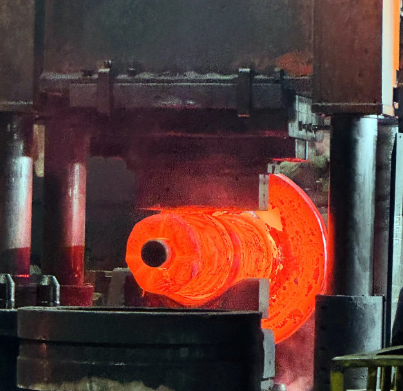
Grain Flow, Internal Integrity and Fatigue Strength Compared
Forging mechanically works the heated material and can refine the internal structure when the correct deformation ratio and process controls are applied. Rolled bar is also mechanically worked, but its properties and available cross-sections are determined by the mill’s rolling process.
| Evaluation Factor | Open-Die Forged Shaft | Rolled-Bar Shaft | Buyer Consideration |
| Shape flexibility | Can be forged into stepped, tapered or shouldered preforms | Usually supplied with a constant round cross-section | A forged preform can reduce material removal on stepped shafts |
| Grain structure | Deformation can refine the structure and develop properties suited to the forged shape | Properties are primarily developed along the rolling direction | Review longitudinal and transverse property requirements |
| Internal integrity | Forging can consolidate the material when sufficient reduction is achieved | Quality depends on bar-production controls and the original billet | Neither route eliminates the need for appropriate ultrasonic testing |
| Fatigue performance | Well suited to high-load applications when forging, heat treatment and machining are properly controlled | Can be suitable for moderate or predictable loads with adequate design margins | Surface finish, fillet radius and heat treatment may be as important as the starting route |
| Material utilization | A shaped preform may reduce machining waste | A large constant-diameter bar may require extensive stock removal | Compare purchased weight with final component weight |
A forged shaft should not automatically be assumed to have superior properties. Its performance still depends on the original material quality, forging reduction, temperature control, heat-treatment cycle and inspection results. Likewise, a certified rolled bar may be fully adequate for a properly designed shaft operating under less severe conditions.
Fatigue cracks commonly begin at geometric transitions or surface discontinuities. Generous fillet radii, controlled keyway geometry, suitable surface finish and the removal of machining marks can therefore influence shaft life as much as the choice between forged and rolled stock.
Size Limits, Machining Allowance and Dimensional Control
One of the strongest reasons to select open-die forging is access to large or non-standard starting dimensions. The process can produce a rough cylindrical or stepped shape without the dedicated cavity tooling required for closed-die forging. The forged blank is then heat-treated and machined to its final dimensions.
Additional stock must be provided for scale removal, surface cleanup, decarburization, heat-treatment distortion and machining setup. If the allowance is too small, surface defects or dimensional variation may remain after finishing. If it is excessive, material cost and machining hours increase unnecessarily.
Rolled bar normally offers a more consistent starting diameter and surface, which can simplify machining for a straight shaft. However, a shaft with several large diameter changes may require most of the original bar to be removed. In that situation, the lower initial material price can be offset by longer cutting time, higher tool consumption and lower material yield.
The manufacturing route must also match the actual component. For example, a project involving turbine shaft forging may use a near-net closed-die route for certain gearbox input or output shafts, while larger rotor-style shafts may be better suited to open-die production. Size, geometry, quantity and performance requirements should determine the route rather than the application name alone.
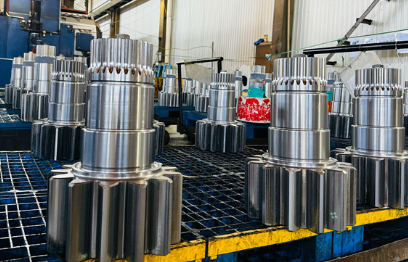
Before setting the forging allowance, the supplier should review the final drawing, datum system, straightness requirement, machining sequence, test locations and required heat-treatment condition. Critical areas such as bearing seats, coupling faces, splines, threads and keyways need enough stock for final machining without creating unnecessary waste across the entire shaft.
Material and Heat Treatment Selection for Large Shafts
Walkson’s open-die capability covers carbon steel, alloy steel, stainless steel, aluminum, titanium and nickel-based alloys. The correct grade should be selected from operating load, temperature, corrosion exposure, weldability and required mechanical properties rather than from shaft size alone.
Common shaft materials can include medium-carbon steels for balanced strength and machinability, chromium-molybdenum steels for higher torque and fatigue demands, and nickel-chromium-molybdenum steels for more severe loading. Walkson’s published shaft-material range includes grades such as C45E/AISI 1045, 42CrMo4/AISI 4140 and 34CrNiMo6/AISI 4340 for applicable programs.
When elevated temperature, oxidation or aggressive corrosion controls the design, Walkson can also produce nickel alloy forgings in materials that include Inconel, Hastelloy, Monel, Waspaloy, Rene and Nimonic alloy families. The precise alloy and manufacturing route must be confirmed against the customer’s specification.
Heat treatment should be defined by the required final properties:
Normalizing can refine the structure and provide a more uniform condition before subsequent processing.
Quenching and tempering is commonly used when the shaft requires a controlled combination of strength and toughness.
Stress relieving can reduce residual stress after rough machining or other processing steps.
Induction hardening or nitriding may be considered for localized wear surfaces, depending on the grade and design.
The purchase specification should define mechanical properties, hardness range and test locations. Naming a heat-treatment process without stating the required results can leave too much room for interpretation.
Tooling, Lead Time, Total Cost and RFQ Requirements
Rolled bar often has the shorter lead time when the required grade and diameter are already in stock. Its purchasing route is simpler because no forging operation is required. Nevertheless, availability can change quickly for large diameters or specialized alloy grades, and an oversized bar may add substantial machining time.
Open-die forging does not require the expensive dedicated tooling associated with closed-die production, making it suitable for large components, prototypes and smaller production quantities. Its lead time may include ingot or billet procurement, process planning, forging, preliminary heat treatment, rough machining, final heat treatment and inspection.
Total cost should include:
Starting material or forged-blank price
Tooling and manufacturing setup
Material removed during machining
Machining time and cutting-tool consumption
Heat treatment and straightening
Mechanical testing, NDT and dimensional inspection
Risk and cost associated with premature shaft failure
Freight cost based on shipped weight and dimensions
A useful comparison is the cost of an inspected, finish-machined shaft delivered to the required specification. Comparing only the price per kilogram of a forged blank and rolled bar can produce the wrong sourcing decision.
For an accurate technical review and quotation, the RFQ package should provide:
Final shaft drawing and available rough-forging drawing
Material grade and governing standard
Finished dimensions, tolerances, surface finish and GD&T requirements
Heat-treatment condition and required mechanical properties
Ultrasonic, magnetic-particle or other NDT acceptance criteria
Material certification and traceability requirements
Annual quantity, batch size and target delivery date
Whether the quotation should cover a rough forging, rough-machined blank or finished shaft
Frequently Asked Questions About Open-Die Forged Shafts
Is an open-die forged shaft always stronger than a rolled-bar shaft?
No. Open-die forging can provide structural and property advantages for demanding applications, but the outcome depends on material quality, forging reduction, heat treatment and inspection. A suitable rolled bar can perform reliably when its properties meet the design requirements.
When is rolled bar the more economical choice?
Rolled bar is often economical for straight or lightly stepped shafts when the required diameter is available and the machining-removal ratio is reasonable. It can also be suitable for prototypes, repair parts and applications with moderate loads.
How much machining allowance should be added to a forged shaft?
There is no universal allowance. It depends on shaft diameter, length, forging tolerance, heat-treatment distortion, surface condition and machining setup. The forging supplier and machine shop should agree on the allowance before production.
Can rolled bar be used for turbine or gearbox shafts?
It may be used when the design loads, size, material properties and inspection results support the decision. Highly loaded or large shafts may require forged stock, while some near-net gearbox shafts may use closed-die forging. Engineering validation is essential.
What inspections should be specified for a large forged shaft?
A typical inspection plan may include chemical analysis, tensile testing, impact testing, hardness testing, ultrasonic examination, magnetic-particle testing and dimensional inspection. The exact methods, test locations and acceptance criteria should be stated in the purchase specification.
What information does Walkson need to recommend a manufacturing route?
Submit the finished drawing, material specification, heat-treatment requirements, mechanical properties, NDT criteria, quantity and delivery condition. Walkson can then evaluate whether open-die forged stock, another forging route or a simpler material form is appropriate for the shaft.
For a practical cost comparison, request quotations for the same delivery scope and inspection level. Comparing complete, specification-compliant shafts provides a more reliable sourcing decision than comparing raw forging and rolled-bar prices alone.