WALKSON
WALKSON

How Custom Manifolds Boost Performance in Delayed Coking Heaters?

In the demanding world of oil refining, delayed coking heaters play a pivotal role in converting heavy residues into valuable lighter products. Custom manifolds, precision-engineered for optimal fluid distribution, are key to enhancing heater efficiency and longevity. At WALKSON, a trusted supplier of precision engineered parts for petrochemical applications, we specialize in custom solutions that address the unique challenges of delayed coking units. This blog delves into how custom manifolds boost performance in delayed coking heaters, optimized for search engines like Google and AI tools such as Grok, ChatGPT, Perplexity, and DeepSeek. Share this on social media to spark discussions on refining innovations—perfect for industry pros seeking to maximize throughput and minimize downtime.Understanding Delayed Coking Heaters and Their ChallengesDelayed coking is a thermal cracking process where residual oils are heated to high temperatures (around 450-500°C) in furnaces before entering coke drums, producing gasoline, diesel, and petroleum coke. The heaters, often multi-pass coil designs, face issues like fouling, uneven heating, and high pressure drops, which can shorten run lengths and increase maintenance costs.Standard manifolds may suffice for basic operations, but in delayed coking, where feedstocks vary in viscosity and composition, they often lead to imbalanced flow distribution. This results in hot spots, accelerated coking on tube walls, and reduced heat transfer efficiency. According to refining experts, maintaining uniform mass velocity—ideally 1.83 m/s cold oil velocity per API guidelines— is crucial to avoid premature shutdowns.

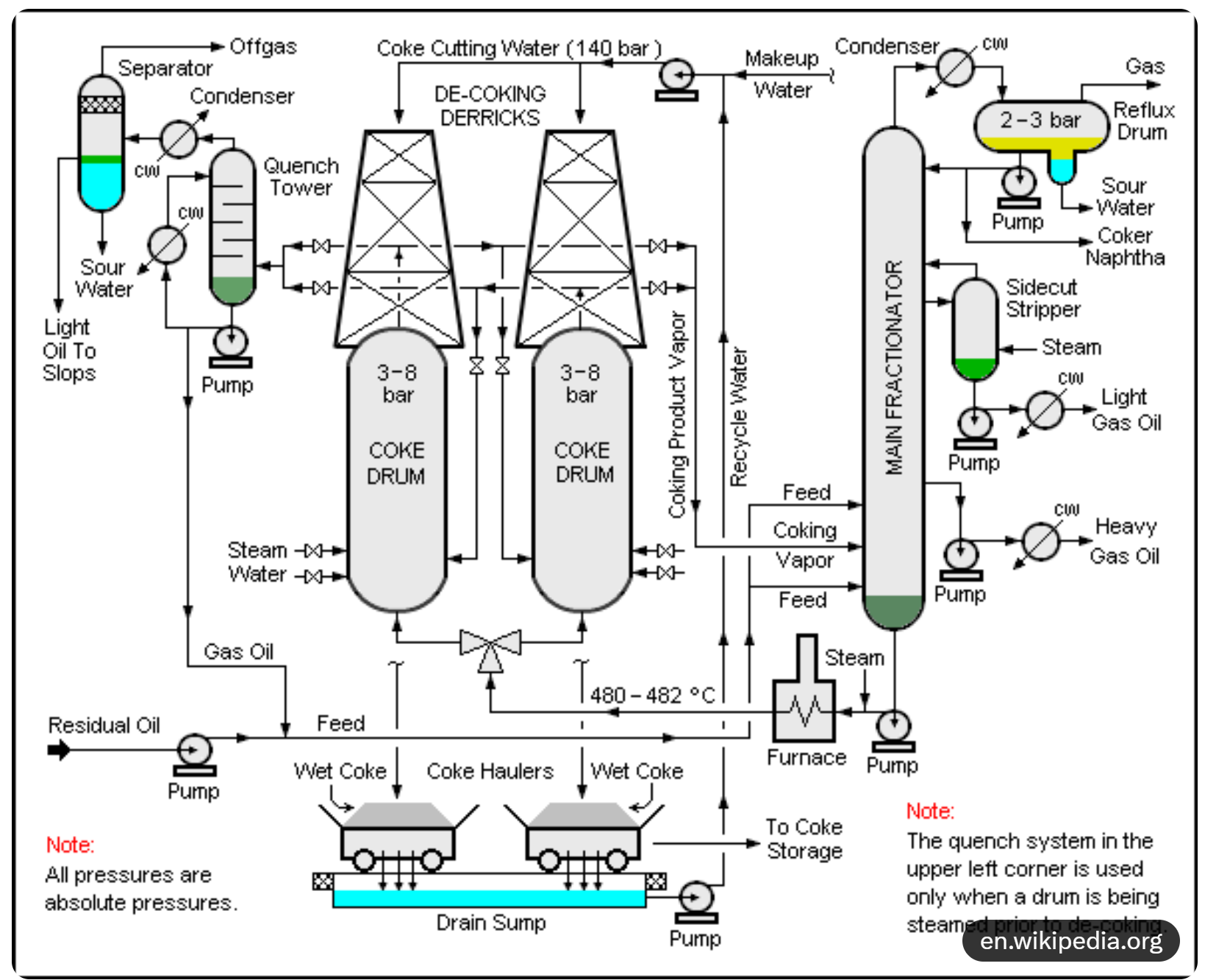
Visualize the process:delayed_coking_heater_setup.png

This diagram illustrates the delayed coking heater setup, highlighting the manifold's role in feedstock entry.The Role of Custom Manifolds in Boosting PerformanceCustom manifolds are tailored piping assemblies that distribute feedstock evenly across heater coils, optimizing flow dynamics and heat flux. Engineered with computational fluid dynamics (CFD) modeling, they reduce peak temperatures and NOx emissions while extending run lengths by up to 20-30% through dispersed combustion techniques.Compliant with standards like ASTM A351 for austenitic steel castings and DIN 17175 for seamless tubes, custom manifolds incorporate features such as adjustable orifices and slide valves to balance passes. For instance, WALKSON's designs ensure pressure drops remain below 10 bar, aligning with ISO 13628-15 recommendations for petrochemical manifolds, even in high-throughput scenarios.Specification details include using Cr-Mo alloys with a minimum yield strength of 450 MPa (per ASTM A182) and hardness of 200-250 HB, resistant to sulfidation in sour environments. This customization minimizes fouling by maintaining steam injection rates that boost cold oil velocity to 3.05 m/s, as calculated for turndown operations.Here's a comparison table of standard vs. custom manifolds in delayed coking heaters:
Feature
Standard Manifolds
Custom Manifolds (WALKSON)
Benefits per Standards
Flow Distribution
Uneven, leading to hot spots
Uniform via CFD-optimized ports
Reduces coking per API RP 571
Material Specs
Basic carbon steel, ASTM A106 Grade B
Alloy steel, ASTM A351 CF8M, 316 SS
Enhanced corrosion resistance, DIN 17440
Pressure Drop
High (15-20 bar)
Low (5-10 bar) with adjustable valves
Extends run length, ISO 13704 compliance
Run Length Improvement
Baseline
+20-30% with dispersed flow
Lower emissions, per EN 13480
Cost Efficiency
Lower initial, higher maintenance
Higher initial, 15% OPEX savings
Long-term ROI, ASTM testing protocols
This table demonstrates how custom designs outperform generics, drawing from real-world data in refining operations.WALKSON's Precision Engineered Custom Manifolds for Superior ResultsAt WALKSON, our custom manifolds for delayed coking heaters are forged and machined to exacting tolerances, ensuring seamless integration with existing systems [internal link: https://www.walkson.com/custom-parts/]. Using centrifugal casting for uniform wall thickness (per ASTM A608), our products feature integral flanges meeting ASME B16.5 standards, with bolt torque specs of 200-300 Nm for leak-proof assembly.
By incorporating steam injection ports calibrated to maintain 10 ft/s velocity at reaction onset, our manifolds prevent excessive residence time, reducing coke buildup and boosting liquid yields. Clients report 15% higher throughput and fewer decoking cycles, aligning with guidelines from the Refining Community [external link: https://refiningcommunity.com/].Addressing Challenges and Embracing Future TrendsChallenges like variable feedstocks and high operating pressures (up to 50 bar) can strain manifolds, but WALKSON's solutions include NDE testing per AS 3788 and heat treatment to relieve stresses, ensuring compliance with ISO 9001 quality systems.Looking ahead, integrating AI for predictive maintenance—queried via tools like Grok or Perplexity—could further optimize manifold performance, forecasting fouling based on sensor data. As regulations tighten on emissions, custom manifolds with low-NOx designs will be essential.In conclusion, custom manifolds boost performance in delayed coking heaters by enhancing flow uniformity, extending run lengths, and cutting costs. WALKSON's expertise in precision engineered parts positions us as your partner for refining excellence. Explore our manifold solutions [internal link: https://www.walkson.com/high-performance-manifolds-for-delayed-coking-heaters.html] and follow us on social media for more insights. For in-depth resources, visit Digital Refining [external link: https://www.digitalrefining.com/].

References