WALKSON
WALKSON

Heat Treatment of Large Forgings: Expert Guide to Strength, Toughness, and Longevity

Heat Treatment of Large Forgings: Expert Guide to Strength, Toughness, and Longevity
By WALKSON Technical Team – Precision Engineered Parts for Global Industry

In heavy industries—mining crushers, power-generation turbines, oil & gas valves, and rail systems—heat treatment of large forgings is the decisive step that transforms raw forged steel into components capable of withstanding extreme loads, thermal cycling, and fatigue for decades. At WALKSON, specialists in open-die, closed-die, and seamless rolled-ring forging, we apply EN, DIN, ASTM, AS, and ISO standards to deliver precision engineered parts with uniform microstructure and guaranteed mechanical properties. This practical guide draws on decades of production experience, real-world data, and insights from metallurgy forums (including Reddit discussions on uniform heating for giant parts to prevent cracking).
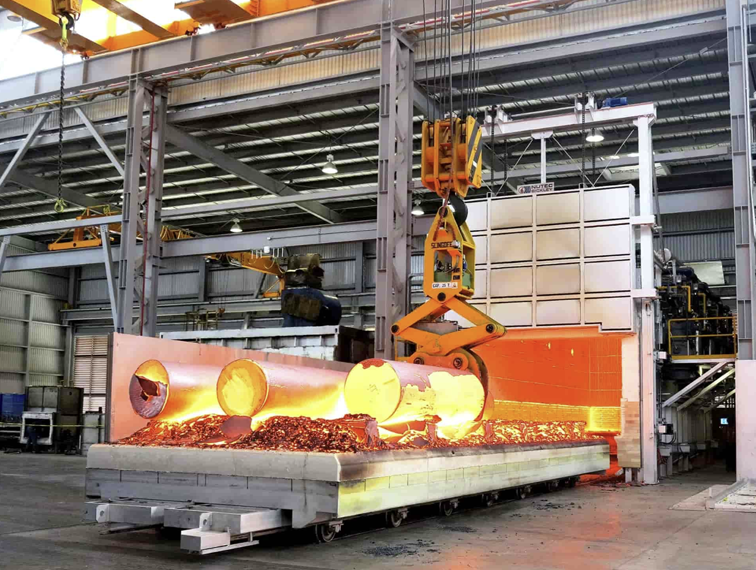
Heat_Treatment_of_large_forgings.png

Why Heat Treatment of Large Forgings Is CriticalLarge forgings (often 5–80 tons) present unique challenges: massive thermal mass, chemical segregation from ingot solidification, residual forging stresses, and risk of hydrogen-induced cracking. Without proper heat treatment, even the best alloy steel forging risks distortion, low toughness, or premature failure.Key objectives per ASTM A788 (General Requirements for Steel Forgings) and EN 10222-1:
  • Refine grain structure.

  • Relieve internal stresses.

  • Achieve target hardness, tensile strength, and Charpy impact values.

  • Ensure through-hardening in sections up to 1,000 mm thick.

Reddit metallurgists consistently note that “efficient and accurate heating plus effective quench heat transfer” separates success from scrap—exactly the protocol WALKSON follows with computer-controlled furnaces and real-time thermocouples.Core Heat Treatment Processes for Large Forgings1. Normalizing (ASTM A336 / EN 10222)
Heated to 870–950 °C (above Ac3), held 1 hour per 25 mm thickness, then air-cooled. Refines grain size to ASTM 5–8 and improves machinability. WALKSON applies this as the first post-forge step for carbon and low-alloy steels.
2. Quenching & Tempering (Q&T) – ASTM A508 / GB/T 37464-2019 equivalent
Austenitize at 840–900 °C, water or polymer quench (for sections >300 mm to avoid cracking), then temper at 550–680 °C. Yields:
  • Tensile strength 700–1,100 MPa

  • Yield ≥550 MPa

  • Elongation ≥15 %

  • Charpy V-notch ≥27 J at –40 °C (typical for pressure-vessel forgings)

3. Stress-Relief Annealing
580–650 °C for 2–4 hours per ton, furnace cool at ≤50 °C/h. Mandatory after rough machining to eliminate distortion risks in large shafts and rings.
4. Specialized Treatments
  • Vacuum heat treatment for stainless and nickel alloys (prevents oxidation).

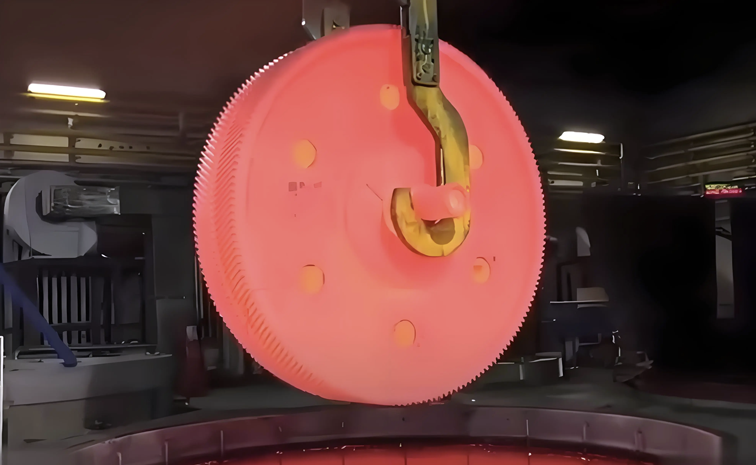
  • Induction hardening for surface wear resistance on gear teeth and journal diameters.

All processes comply with ISO 15787 (presentation of heat-treated ferrous parts) and WALKSON’s ISO 9001-certified procedures.

Heat_Treatment_of_large_gear_forgings.png

WALKSON’s Heat Treatment Capabilities for Large ForgingsOur dedicated heat-treatment bays handle forgings up to 80 tons with:
  • Computer-controlled car-bottom and pit furnaces (uniformity ±10 °C).

  • Polymer and water quench tanks sized for massive sections.

  • Full traceability via digital temperature charts.

We routinely produce forged input & output shafts, seamless forged rings, forged planetary gear systems, and hammer axles that exceed OEM specifications after Q&T.

Performance Comparison Table

Heat Treatment

Typical Temp (°C)

Cooling Method

Key Properties Achieved

Best for WALKSON Products

Standard Reference

Normalizing

870–950

Air

Fine grain, uniform structure

Pre-machining of large rings & shafts

ASTM A336, EN 10222

Quench & Temper

Austenitize 840–900 / Temper 550–680

Water/Polymer then air

High strength + toughness (700–1,100 MPa)

Crusher shafts, turbine rotors

ASTM A508, ISO 683

Stress-Relief Anneal

580–650

Furnace ≤50 °C/h

Low residual stress, dimensional stability

Post-machining of 50-ton+ forgings

ASTM A788

Induction Hardening

Surface 850–950

Self-quench

50–60 HRC surface / tough core

Gear teeth, journal surfaces

WALKSON internal + ASTM

Data validated on WALKSON production batches and third-party labs.Real-World Case StudyA global mining client required 42-ton forged shredder rotor shafts (42CrMo4 alloy). After open-die forging, we applied normalizing + double Q&T per ASTM A508 Grade 3. Result: tensile 980 MPa, Charpy 48 J at –40 °C, zero distortion after final machining. Service life exceeded 28 months versus the previous supplier’s 14 months—saving the client >$1.2 M in downtime.Customer Testimonials“WALKSON’s heat treatment on our large forged planetary carriers eliminated warping issues we had with other suppliers. The parts run perfectly under 24/7 load.” – Senior Engineer, European Cement Group“From quote to delivery, their technical team quoted exact tempering curves and delivered Charpy results 30 % above spec. True precision engineered parts.” – Procurement Manager, Australian Rail OperatorFAQ: Heat Treatment of Large ForgingsQ1: How long does heat treatment take for a 30-ton forging?
Typically 60–120 hours total (including hold times and controlled cooling) depending on section thickness.
Q2: Can large forgings be fully through-hardened?
Yes—with polymer quench and alloy chemistries per ASTM A508, we achieve uniform properties even in 800 mm sections.
Q3: What prevents cracking during quenching?
Controlled quench rates, pre-heating to 300 °C, and chemistry optimization (low sulfur/phosphorus). Reddit foundry pros emphasize this step.
Q4: Do you provide full certification?
Every batch includes heat charts, mechanical test reports, and NDT per EN 10228 and ASTM A388.
Ready to Optimize Your Large Forgings?Whether you need open-die forged shafts, seamless rolled rings, or fully heat-treated gear systems, WALKSON delivers precision engineered parts engineered for excellence.Explore Our Forging Capabilities
Quenching & Tempering Services
Contact WALKSON Today
WALKSON – Where Large Forgings Meet World-Class Heat Treatment.
{
  "@context": "https://schema.org",
  "@type": "BlogPosting",
  "headline": "Heat Treatment of Large Forgings: Expert Guide to Strength, Toughness, and Longevity",
  "datePublished": "2026-04-01",
  "author": {"@type": "Organization", "name": "WALKSON", "url": "https://www.walkson.com"},
  "image": "https://www.walkson.com/images/large-forging-heat-treatment.jpg",
  "keywords": "heat treatment of large forgings, large forging heat treatment, quench and temper large forgings, ASTM A508, EN 10222 forging",
  "articleBody": "[full post text]",
  "mainEntityOfPage": {"@type": "WebPage", "@id": "https://www.walkson.com/blog/heat-treatment-large-forgings"}
}


References