 English
  Deutsch
  français
  русский
  فارسی
فارسی  العربية
  Español
  日本語
日本語  한국어
한국어  italiano
  português
  dansk
dansk  Suomi
Suomi 


The best mill liner material depends on the balance between impact, abrasion, ore characteristics and operating cost. CrMo steel is generally suited to high-impact service, high-chrome white iron prioritizes abrasion resistance, manganese steel benefits from repeated impact and work hardening, while metal matrix composites combine a tough metallic base with wear-resistant ceramic reinforcement. No single material is ideal for every grinding circuit.
How to Choose a Mill Liner Material: The Short Answer
Material selection should begin with the dominant failure mechanism. If existing liners crack, fracture or deform under large impacts, toughness should receive more weight than maximum hardness. If the liner profile gradually wears away without major cracking, abrasion resistance is usually the greater concern.
When replacing mill liners, buyers should evaluate the complete operating environment rather than compare hardness values alone. Mill type, ore hardness, feed size, grinding media, mill speed, liner position and expected maintenance intervals all influence the result.
A practical starting point is:
Choose CrMo steel when impact toughness and resistance to cracking are the priorities.
Consider high-chrome white iron for highly abrasive service with controlled or moderate impact.
Use manganese steel where repeated impacts can activate its work-hardening behavior.
Evaluate MMC when conventional alloys wear too quickly and the potential reduction in shutdown frequency justifies a higher initial cost.
Final material selection should be confirmed through operating data and, where possible, controlled field trials.
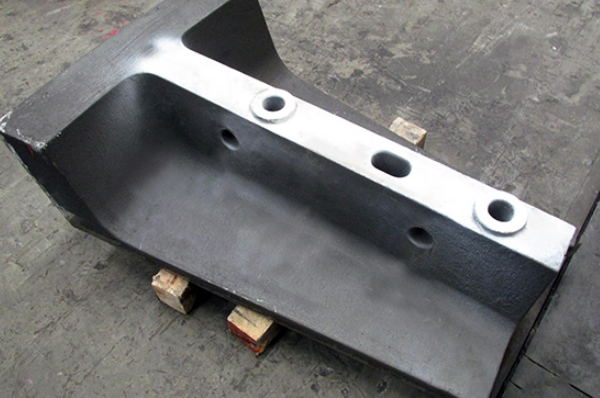
CrMo Steel vs High-Chrome White Iron vs Manganese Steel vs MMC
The following comparison summarizes the general selection logic. Actual performance will still depend on alloy composition, heat treatment, liner geometry and mill conditions.
| Material | Main Advantage | Important Limitation | Typical Selection Scenario |
| CrMo steel | Good impact toughness and resistance to cracking | Lower hardness than high-chrome white iron | High-impact SAG and AG mill shell applications |
| High-chrome white iron | Very high hardness and abrasion resistance | Requires careful evaluation where severe shock loading occurs | Fine grinding and abrasive service with controlled impact |
| Manganese steel | High toughness with work-hardening capability | Needs sufficient repeated impact to develop the hardened surface | Impact-intensive wear applications |
| MMC | Combines a tough metal base with ceramic wear reinforcement | Higher initial cost and greater design complexity | Localized severe wear or applications with costly shutdowns |
Walkson publishes a typical final hardness of 350–402 HBW for its CrMo steel and at least 621 HBW for its high-chrome white iron used in liner applications. These values help explain the different roles of the two materials, but hardness should not be treated as a direct prediction of service life.
For equipment exposed to repeated impact and abrasion, Walkson’s manganese liners are available in Mn13 and Mn18 alloys. Their surface can harden during service while the underlying material retains toughness. However, low-impact conditions may not generate enough work hardening to deliver the expected benefit.
MMC designs add wear-resistant ceramic reinforcement to a metallic substrate. Walkson offers configurations based on materials such as high-manganese steel, high-chrome cast iron or martensitic steel. The objective is to place greater wear resistance where it is needed while retaining structural support from the metal base.
Matching Liner Materials to SAG, AG, Ball and Rod Mills
SAG and AG mills process relatively large feed and can expose shell liners and lifter bars to substantial impact. CrMo steel is often a practical starting point because toughness and crack resistance are critical when large pieces of ore and grinding media strike the liner. An MMC solution may be considered for specific high-wear zones, but the transition between the reinforced area and the base metal must be engineered carefully.
Ball mills used for finer grinding may create a more abrasion-dominated environment. Where impact is controlled, a white iron mill liner can provide the high hardness needed to resist abrasive mineral particles. Walkson supplies high-chrome white iron grades aligned with standards such as ASTM A532 and AS 2027, with the precise grade selected according to impact level and wear conditions.
Rod mills generate line contact between rods and processed material. Their liner selection must account for feed size, rod charge, mill speed and the balance between sliding wear and impact. CrMo steel may be preferred when impact remains significant, while more abrasion-resistant alternatives can be evaluated where wear is gradual and fracture risk is low.
Manganese steel should not automatically be specified for every mill simply because it is tough. It performs best where service impacts are frequent and energetic enough to produce work hardening. If the load is mainly low-impact abrasion, high-chrome or composite materials may offer a better wear mechanism match.
How Ore Hardness, Feed Size and Impact Load Affect Liner Life
A material comparison is only useful when it is connected to actual operating conditions. Buyers and engineers should review five factors before finalizing a specification:
Ore hardness and abrasiveness: Mohs hardness provides useful context, but mineral composition, quartz content, particle shape and abrasiveness can be equally important.
Feed-size distribution: Large or inconsistent feed can increase impact severity. A liner selected only for fine, abrasive material may crack when exposed to repeated oversized feed.
Grinding-media size and charge: Larger media and an aggressive charge trajectory increase impact energy. Mill speed and lifter design also affect where the charge lands.
Existing failure pattern: Cracks, broken edges, deformation, smooth thinning and localized deep wear point to different problems. Inspection photographs often provide more useful evidence than average service-life figures alone.
Liner position: Feed-end liners, shell plates, lifter bars and discharge-end components do not necessarily experience the same loads. Using one material throughout the mill may simplify purchasing but may not minimize total cost.
Operating conditions can also change over time. A new ore source, higher throughput target or modified grinding-media charge can make a previously successful material unsuitable. Liner performance should therefore be reviewed whenever the grinding circuit changes.
Comparing Liner Life, Downtime and Total Operating Cost
Purchase price alone does not show whether a liner is economical. The more useful metric is total liner cost per tonne of processed material:
Total liner cost per tonne = (liner purchase cost + freight + installation labor + shutdown cost + disposal cost) ÷ tonnes processed during the service period
A material that costs more initially may still reduce total cost if it extends the maintenance interval or prevents an unplanned shutdown. Conversely, the hardest or most advanced material may not provide a return when installation labor is low, shutdowns are already aligned with other maintenance, or the liner fails from impact rather than wear.
Walkson states that its ceramic-composite liner designs can achieve up to approximately twice the service life of conventional high-chrome liners under suitable conditions. This should be treated as application-dependent supplier data rather than a guaranteed result for every mill. A field comparison should use equivalent positions, operating periods and throughput so the results are meaningful.
For a material review or quotation, prepare:
Mill type, model, dimensions and operating speed
Liner drawings, dimensions and individual component weights
Current material grade, hardness and heat treatment
Ore type, feed-size distribution and available hardness data
Grinding-media size and charge
Current service life and replacement interval
Photographs showing worn, cracked or fractured areas
Required material certificates, dimensional reports and NDT records
Providing this information allows the supplier to evaluate the failure mechanism instead of simply reproducing the current liner.
Frequently Asked Questions About Mill Liner Selection
What is the strongest material for a mill liner?
There is no universally strongest option. CrMo steel offers a useful combination of toughness and wear resistance, while high-chrome white iron delivers greater hardness. Manganese steel relies on impact-induced work hardening, and MMC combines a metal base with ceramic reinforcement. The correct choice depends on whether impact, abrasion or a combination of both controls liner failure.
Is a harder liner always more wear-resistant?
Higher hardness can improve resistance to abrasive wear, but excessive hardness without sufficient toughness may increase the risk of cracking or fracture. Hardness must be considered together with microstructure, heat treatment, impact load and liner geometry.
When should MMC be considered?
MMC is most relevant when conventional liners experience rapid, predictable wear and shutdowns are expensive. It can also be used selectively in high-wear zones instead of converting every liner component to a composite design.
Can one liner material be used throughout an entire mill?
It is possible, but it is not always the most economical approach. Different mill zones can experience different combinations of impact, abrasion and material flow. A position-specific material strategy may produce longer overall campaigns.
What quality documents should be requested?
Depending on the project, buyers may request chemical-composition results, hardness reports, heat-treatment records, dimensional inspection reports, batch traceability and material certificates. UT, MT or PT results can also be specified where the liner design or service conditions require non-destructive testing.
How can liner material selection be validated before a full conversion?
Begin with a controlled field trial in clearly identified positions. Record installation dates, liner weights or thicknesses, processed tonnage, operating hours and removal condition. Compare the trial components with conventional liners working under similar conditions before making a full-mill decision.
To receive a material recommendation, submit your liner drawings, current alloy, operating conditions and wear photographs. Walkson’s engineering team can review the available information and propose a CrMo, high-chrome white iron, manganese steel or MMC solution for further technical evaluation.